Master thesis (TUM × BMW): physics-guided generative models synthesize low-pressure-drop flow manifolds, with fluid topology optimization in PhiFlow.
SlidesKartik Bali
PhD Candidate · Helmholtz-Zentrum Hereon & TU Hamburg
I research how vision-language models perceive, reason and reconstruct 3D geometry: deciding where to look, grounding language in geometry, and turning what they see into executable programs. In short, I teach AI to look at 3D objects and understand them the way an engineer would. Along the way I work on RL post-training with execution rewards and on probing what these models actually rely on. I collaborate closely with DFKI.
Before my PhD, I did my M.Sc. in Computational Science & Engineering at the Technical University of Munich, with a master thesis at BMW on physics-guided generative models, supervised by Prof. Nils Thuerey. I hold a B.E. in Mechanical Engineering from BITS Pilani, Hyderabad. Outside research, I play lead guitar and sing.
I am looking for research internships in 2027. Feel free to reach out!

News
- Oct 2026Looking for research internships for 2027.
- Oct 2026FRAME accepted at npj Computational Materials!
- Oct 2026Look Where You Can (SightCAD) preprint is on arXiv.
- Sep 2026GReFEM accepted at NeurIPS 2026! Paper on arXiv, code on GitHub.
- Jul 2026MV-GEL accepted at ECCV 2026! Code and paper are online.
- Jan 2025Started my PhD at Helmholtz-Zentrum Hereon.
Research
First-author papers
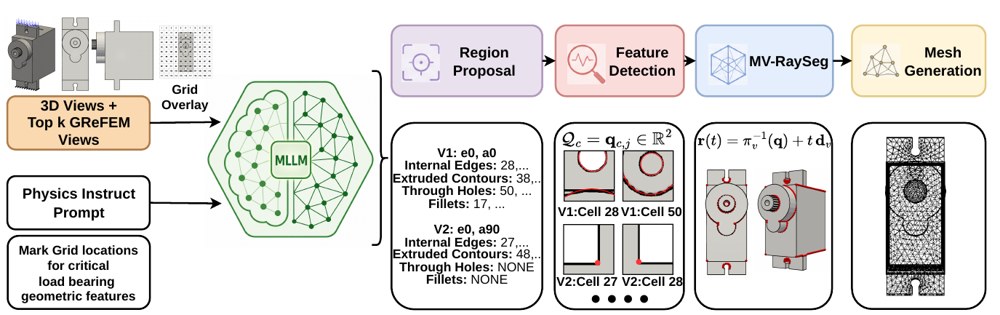
GReFEM: Multimodal LLMs as Zero-Shot Semantic Assistants for Physics-Guided 3D Mesh Refinement
NeurIPS 2026 ACCEPTED
Can off-the-shelf multimodal LLMs serve as zero-shot geometric proxies for physics? We ask MLLMs to localize stress-critical regions from physics-guided prompts, bridging 2D pre-training and 3D geometry with orthoViews, a trained view-selection module that maximizes feature observability. Without any FEM solve or simulation training data, GReFEM closes 58% of the gap between the unrefined mesh and a reference-solve oracle at a matched element budget, and we map where MLLMs succeed and where they still fall short.
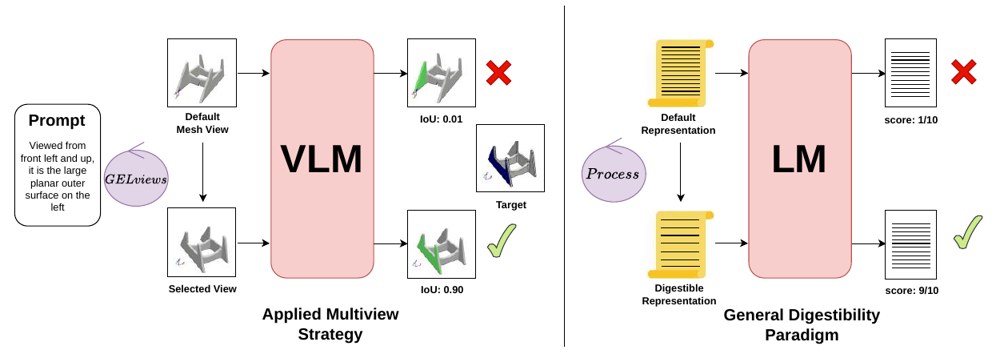
MV-GEL: Language-Driven Multi-View Geometric Entity Localization on Meshes
ECCV 2026 ACCEPTED
Grounding fine-grained geometric entities (edges, planar regions, curved surfaces) on 3D meshes from natural language. Prompt-conditioned view selection over a VLM reasoning-segmentation backbone, lifted to the mesh with geometry-aware ray casting. Up to 1.7× face-level IoU and 4.5× edge-level F1 over CLIP-based and random-view baselines.
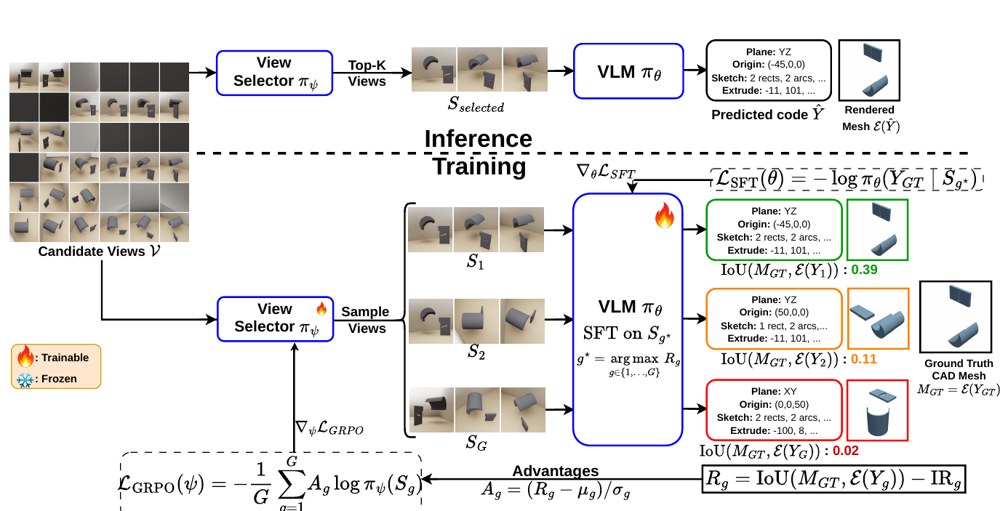
Look Where You Can: Active View Selection for CAD Reconstruction under Occlusion
Preprint, 2026 UNDER REVIEW
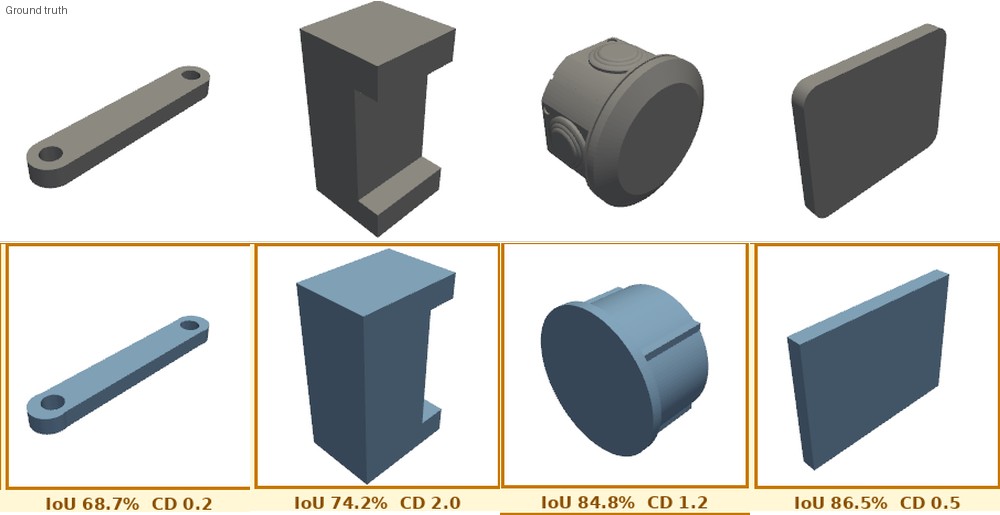
Real objects are scene-embedded: walls, floors, and corners make much of the view sphere unreachable. A learned view selector picks feasible views for a VLM that writes executable CadQuery code, and both are trained jointly with RL against execution reward. Outperforms strong baselines by +21 / +17 effective-mIoU on occluded DeepCAD / Fusion360, transfers to real T-LESS and MP6D images, with ≤1.5% invalid code. Layer-wise ablations of each view's visual tokens give a mechanistic account of which views make which program parameters legible to the VLM. (Hover: ground truth vs. our reconstructions on DeepCAD, Fusion360 and T-LESS.)
Ongoing
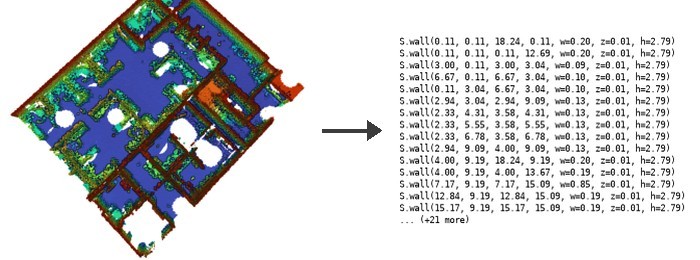
Point2BIM: From Real Laser Scans to Executable Building Programs
ONGOING
Turning real terrestrial laser scans of buildings into executable BIM programs (exported to IFC4) with vision-language models. Training with SFT followed by GRPO on execution-based geometric rewards, and targeting generalization to real scans rather than synthetic scenes.
Co-authored
- J. Minder, V. Moskvoretskii, R. Singhal, D. Jiao, A. Arditi, S. Cui, Y. Borjigin, K. Bali, S. Krsteski, H. Raj, H. Nguyen, J. Brinkmann, A. Anderson, R. Aydin, R. West. Synthetic Persona Pretraining: Alignment from Token Zero. Preprint, 2026. [arXiv]
- M. K. Guru, V. Gupta, K. Bali, et al. From Finite Element Analysis to Self-Optimization: FRAME (Finite element Reasoning and AI-Agent Model Engine) and the Era of Agentic AI in Engineering. npj Computational Materials, 2026 (accepted).
- M. Tacke, …, K. Bali, et al. Constitutive Scientific Generative Agent (CSGA): Leveraging Large Language Models for Automated Constitutive Model Discovery. Machine Learning for Computational Science and Engineering, 2025.
- B. List, L.-W. Chen, K. Bali, N. Thuerey. Differentiability in Unrolled Training of Neural Physics Simulators on Transient Dynamics. Computer Methods in Applied Mechanics and Engineering (CMAME), 2025. [arXiv]
- K. Bali, K. Supradeepan. Numerical Analysis of Flow Past an Oscillating Circular Cylinder using Arbitrary Lagrangian Eulerian Consistent Flux Reconstruction Scheme. 2019. [arXiv]
Experience
- Jan 2025 – nowPhD Candidate, Helmholtz-Zentrum Hereon, Hamburg. VLMs for 3D geometry, view selection, RL post-training.
- Sep – Dec 2024AI Engineer, Project-S and Beyond Technologies, Munich. ML for radar perception and signal processing.
- Sep 2023 – May 2024Master Thesis, BMW AG, Munich. Physics-guided diffusion models and GANs accelerating 2D/3D flow-geometry design by 2× (grade 1.0).
- May 2022 – Aug 2023ML Working Student, TUM Thuerey group. GNNs and ResNets for chaotic PDEs; CI/CD for PhiFlow.
- EarlierSoftware Engineer, L&T Construction. Smart engineering solutions.
Earlier Projects
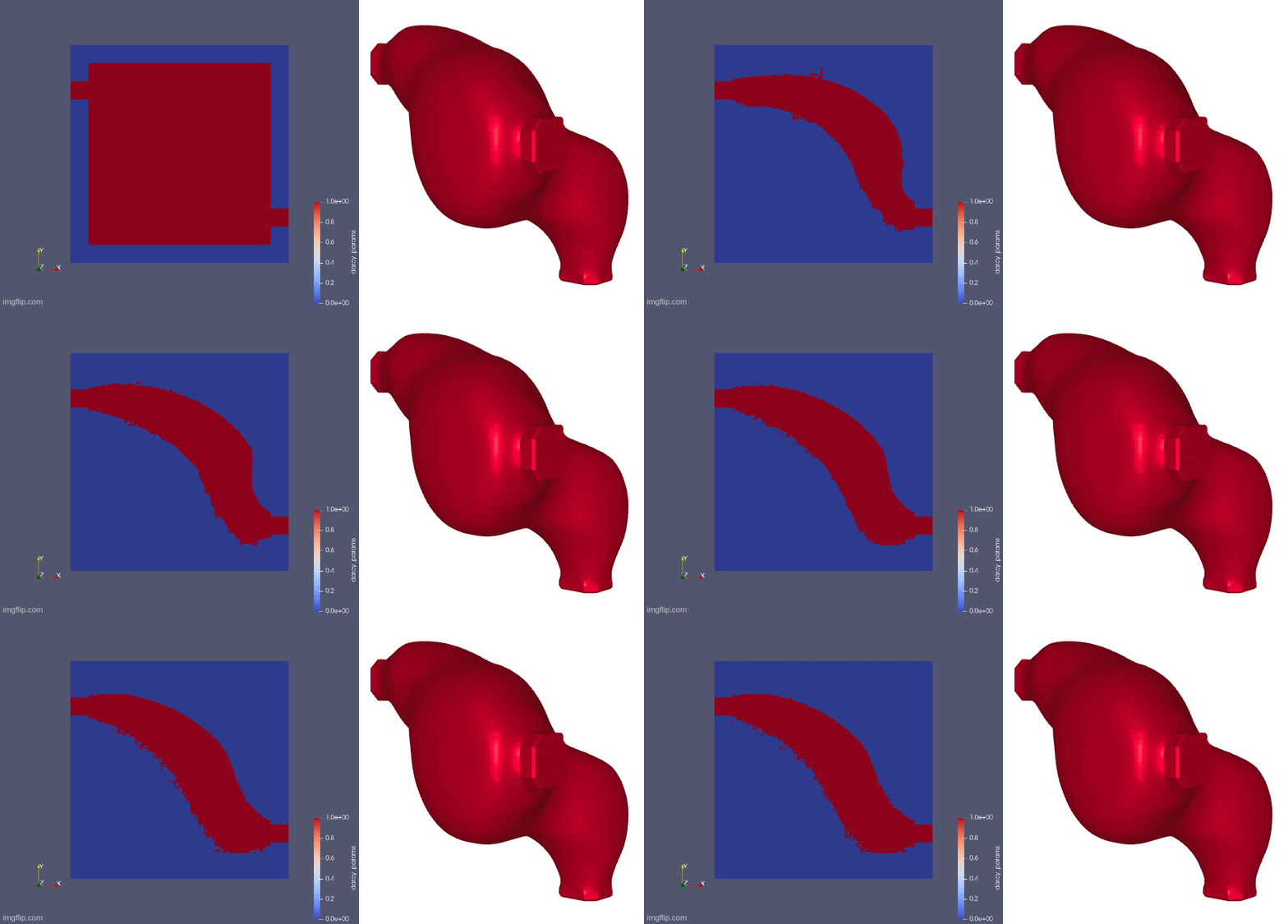
Generative Geometry Design for CFD
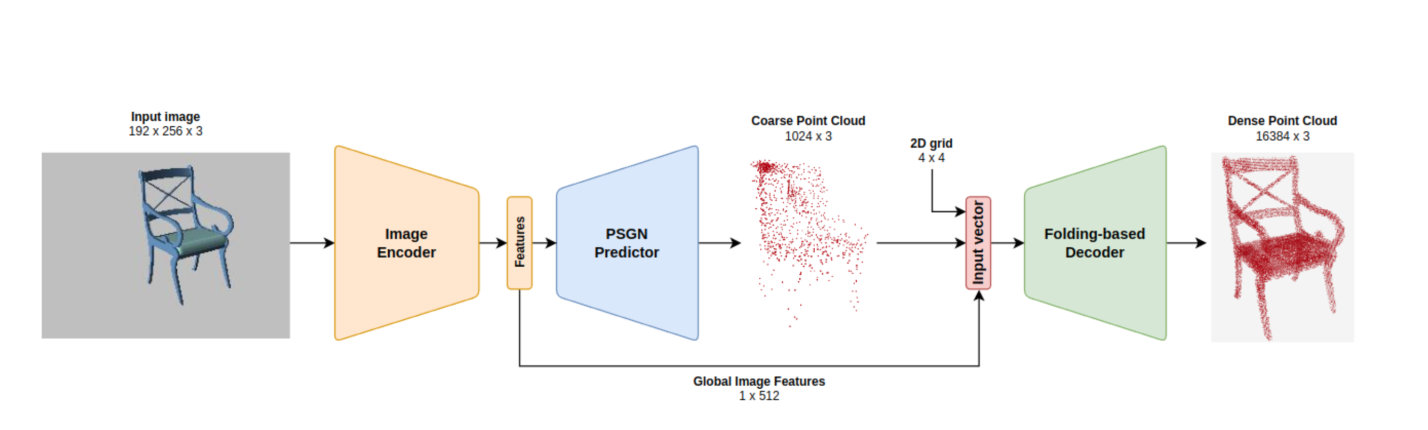
Dense Point Clouds from a Single RGB Image
Two-stage point set generation with an encoder-predictor and folding decoder (ML for 3D Geometry, Prof. Angela Dai).
Report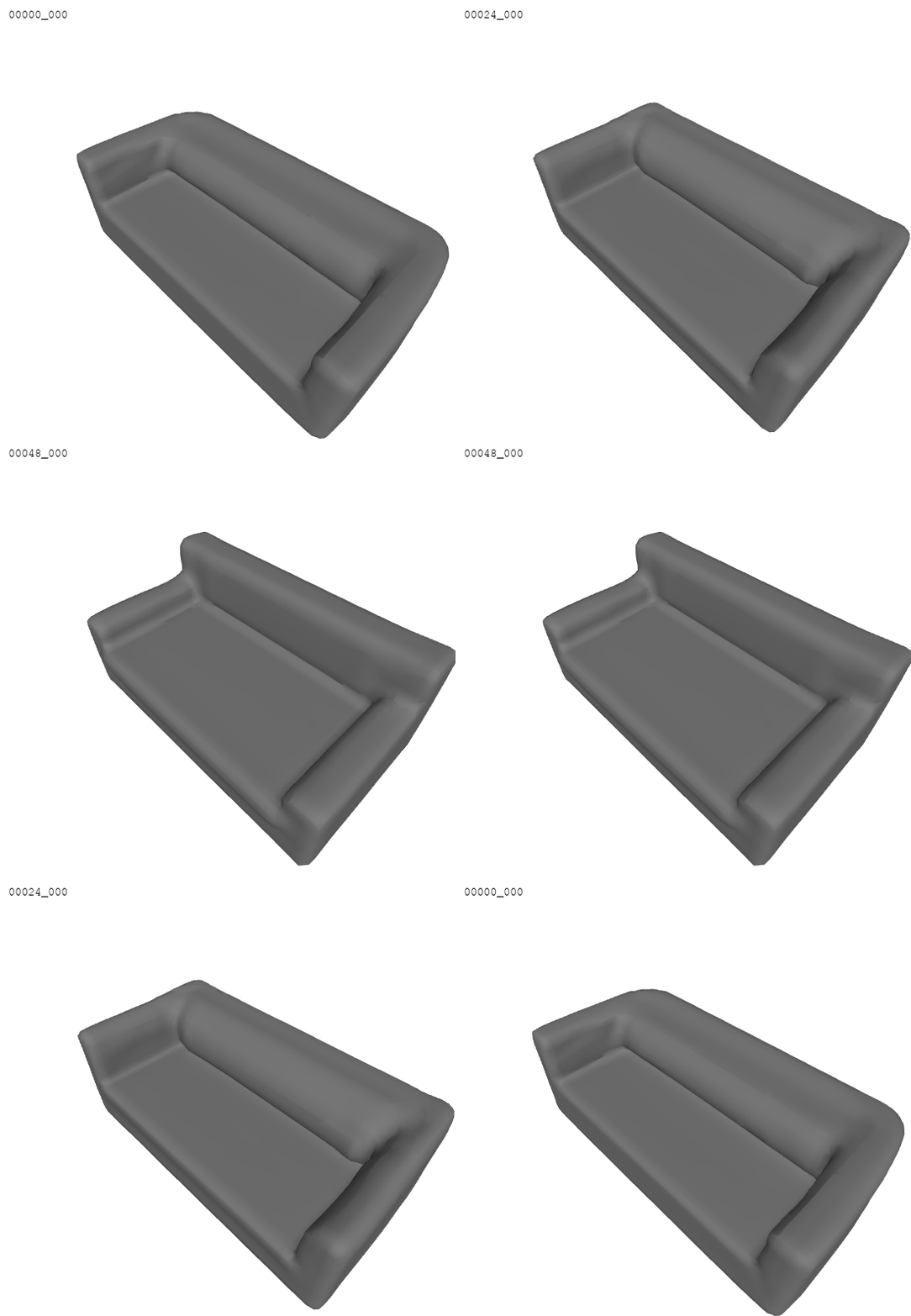
3D Shape Completion with DeepSDF & 3D-EPN
Continuous SDF shape representations on ShapeNet: completion and latent interpolation.
Code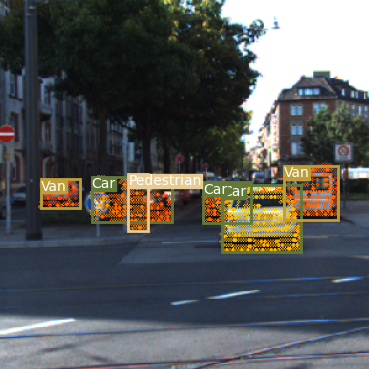
Object Detection with LiDAR Fusion
YOLOv3 and SSD on KITTI; L2-norm pruning for faster SSD inference and early LiDAR fusion.
Code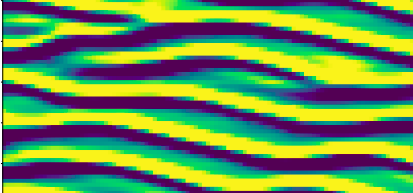
GNNs for the Kuramoto–Sivashinsky Equation
Message-passing GNNs and CNNs with temporal unrolling for chaotic PDEs; led to the CMAME 2025 paper.
Paper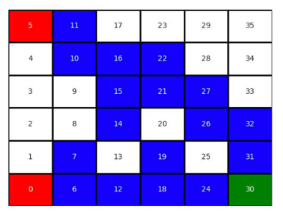
Topology Optimization with RL in JAX-FEM
Double-Q agent with JAX-FEM as the environment (TUM Data Innovation Lab).
Report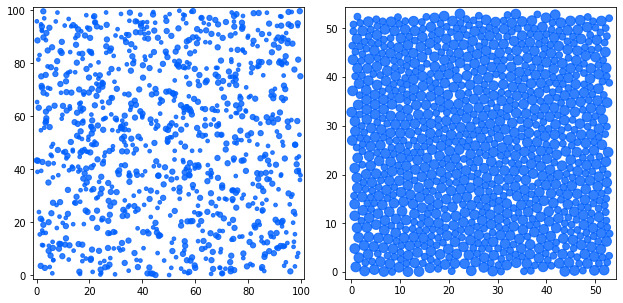
Sphere Packing via Differentiable Physics
Gradient-based minimization of overlap energy to find optimal 2D packings in PhiFlow.
Code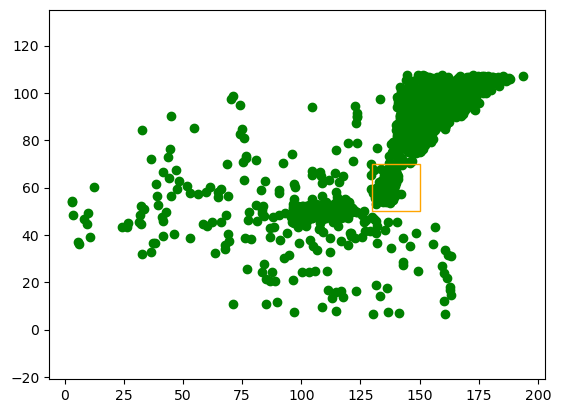
Pedestrian Distributions with VAEs
Learning crowd distributions in the TUM MI building for evacuation scenarios.
Code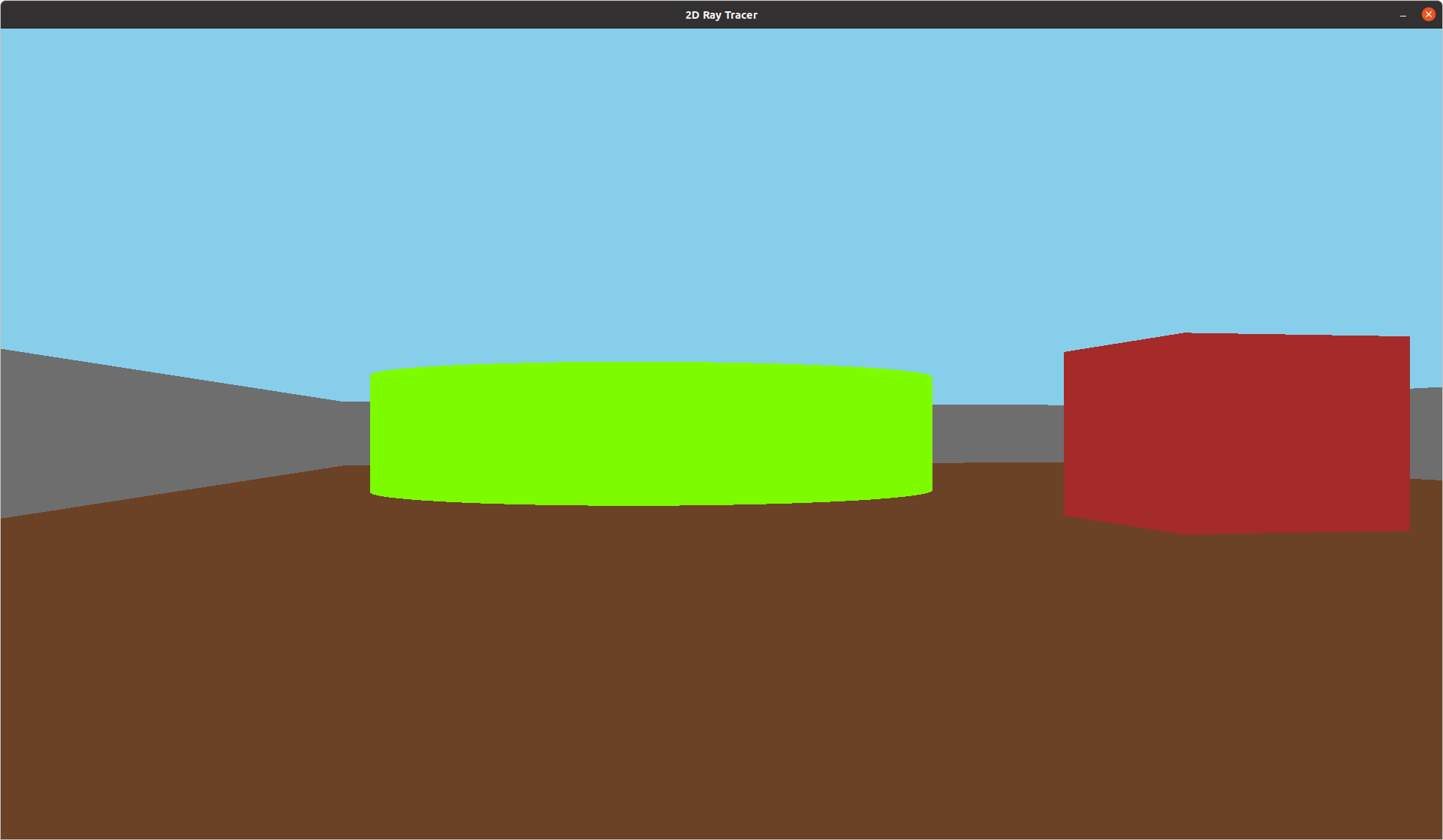
Interactive 3D Ray Tracer
First-person ray-tracing app in C++ with SDL2.
Code